
Chapter 25:
Friday has a specific quality that the other days don't have.
Not better. Not lighter. Just — different. The specific quality of a day that knows it's the last one before the week releases, that has a particular texture of almost-there, of the weekend existing just past the edge of it like a room you can smell before you open the door —
I take the long way around.
Obviously.
The vending machines. Three. Still three. The delay, the stuck button, the three-inch drop. All present. All running their usual programs with the specific reliability of things that have no investment in variety —
The verdict is still in the mirror.
I left it there this morning. I said what I said to the 47 by 60 centimeter surface and then I turned the shower on and waited forty seconds and made toast and came to school and the verdict is still there, still in the bathroom, still sitting in the specific location where I left it —
I'm not going to think about the verdict.
I'm going to think about the east exit.
She's there.
Kana Kawamaru is at the east exit.
Not the main entrance. Not the front of the school where people wait for rides and stand in groups and have conversations that require participants to have faces that do things. The east exit. My exit. The side street with the vending machines and the specific quality of an entrance that registers as empty, as not-a-place-anyone-chooses —
She chose it.
She found the route and she found the exit and she is standing at it with her bag held close to her chest and her shoulders doing the thing — the specific thing, the taking-up-less-space-than-the-body-allows thing, the thing I recognized Thursday morning from twenty meters away in a different configuration —
She's very still.
Not confident stillness. Not the stillness of someone who has decided the space is theirs and is comfortable in it. The stillness of someone who has learned that small and unmoving is a form of protection, that if you don't move you don't draw attention, that if you don't draw attention nothing can be aimed at you —
I know this stillness.
I've built a whole operating system around it.
I adjust my direction.
Not a decision exactly. Just — the feet finding the correct path the way they always find the correct path, the body voting without consulting anyone, the direction changing before the background process has weighed in on whether changing the direction is the right call —
She sees me coming.
Something in her face.
The hope and the suspicion arriving simultaneously, running in parallel, neither one winning — the hope that says I came back, I'm here, I showed up at your exit because I meant what I said about first friend — and the suspicion that says but there's always a cost, there's always a moment where the protection reveals its price, there's always —
I stop in front of her.
"You found the exit," I say.
She looks at me.
Then at the exit.
Then at me.
"I — I asked," she says. The stutter arriving and steadying in the same breath. "Someone said you always use the — the east exit so I —" She stops. "I hope that's okay."
I look at her.
The steady eyes.
Her neck has —
I'm filing her as ordinary.
The filing takes the time it takes.
"It's okay," I say.
She exhales.
Small. The specific exhale of someone who has been holding something and has just been told they can put it down.
We stand at the east exit for a moment.
The side street doing its side street thing. The vending machines. The specific quality of a Friday morning that hasn't fully committed to being a day yet —
"Are you —" she starts.
Stops.
Starts again.
"Are you actually okay," she says. "With — with me being here. I know I said I wanted to be your friend but I know you didn't really — you didn't ask for that, you just said okay and I don't know if okay meant yes or okay meant I'll allow this temporary proximity or —"
"It meant yes," I say.
She looks at me.
"It meant yes," I say again. "That's all it meant."
Something on her face.
The edge of something.
The something getting closer to its complete form than it's been since I met her —
"Okay," she says.
Quietly.
Just that.
And we go inside.
Walking to class with Kana Kawamaru is different from walking to class with Sky.
Sky fills the corridor. Sky generates a specific ambient energy that precedes her and trails after her and makes the space she moves through feel like it's been rearranged slightly by her passage. Walking with Sky is being in the proximity of a weather event.
Kana is different.
Kana moves through space the way she stands in it — carefully, taking up exactly the amount of room she needs and not one centimeter more, not announcing her presence, not requiring the corridor to reorganize itself around her —
She's been doing this for a long time.
Making herself small enough that nothing gets aimed at her.
I think about Thursday morning.
The three of them around her by the equipment shed. The geometry. The specific way she was holding her bag against her chest — the same way she's holding it now, I realize, the same position, the same instinctive defense mechanism operating whether or not there's anything to defend against —
She's always prepared for something to be aimed.
Even now.
Even walking to class on a Friday morning with someone who said it meant yes.
I don't say this.
"Do you —" she starts, then stops. The stutter not arriving this time — just the hesitation, just the person behind the stutter deciding whether the sentence is safe to finish. "Do you always take the long way."
"Yes," I say.
"Why."
I consider this.
"The main corridor costs more than it's worth," I say.
She looks at me sideways.
"That's —" She stops. "That makes sense," she says. "Actually."
"Most things make sense if you follow them far enough back," I say.
She considers this.
"I take the long way too," she says. "Not the same one. But — I add time. To get to places. So I don't have to — so there are fewer people in the corridors when I'm in them."
I look at her.
She's looking at the floor ahead of us.
"It adds eleven minutes," she says. "Total. Per day."
I've added approximately forty minutes.
I don't say this.
"Eleven minutes is reasonable," I say.
Something on her face.
The complete form.
It is, I note with the specific precision of someone who has been cataloguing faces for two years, a very small smile.
I file it.
Then I file her as ordinary and move on.
The filing takes longer than it should.
She is waiting at the corner of the main building.
I know it's her before I see her because of the baseball.
There is no baseball this time. But there is a specific quality of a person who is carrying something with the specific energy of someone who has been waiting to deploy it and is now calculating the optimal moment of deployment —
Sky.
With a bag.
A suspiciously large bag for a person who does not typically carry large bags.
"Mii-chan," she says.
I look at her.
"What," I say.
She opens the bag.
The uniform.
The wig.
Kana looks at the bag. Looks at Sky. Looks at me. Looks at the bag again.
"No," I say.
"Surprise," Sky says.
"I said no."
"You said no last time too," she says. "And then you did it anyway. We've established the pattern. The pattern is: you say no, you do it anyway, you look —"
"Don't say it."
"— remarkably —"
"Don't."
"— well-suited to the aesthetic," she finishes. "I wasn't going to say anything else."
"You were going to say cute," I say.
"I was going to say well-suited to the aesthetic," she says, with complete innocence. She looks at Kana. "You."
Kana points at herself.
"Yes you," Sky says. "I need your arms."
"My —"
"Your arms," Sky says. "Specifically for holding purposes. Specifically for holding a specific person who is going to try to run in approximately —" she looks at me, "— forty-five seconds."
Kana looks at me.
I look at Kana.
"You don't have to," I say.
Kana looks at the bag.
Looks at Sky.
Looks at me.
Something moves through her face — the cautious hope version, the one that's deciding whether this is the kind of thing that costs something or the kind of thing that is just — Chloe on the counter, just tamagoyaki, just two people in a corridor agreeing to something without knowing what it looks like —
She takes a position behind me.
"I'm sorry," she says to me, very quietly, with the specific sincerity of someone who means it and is doing the thing anyway. "I think this will be okay."
Her arms close around mine.
The grip is gentle.
Also completely effective.
"Kana," I say.
"I'm sorry," she says again.
"This is a betrayal."
"I know," she says. "I'm sorry."
"You keep saying sorry."
"I keep meaning it," she says.
I look at Sky.
Sky looks at me with the specific expression of someone who has prepared something and is watching it execute correctly and is finding the execution deeply satisfying —
"The pattern," she says, "has been established."
I change around the corner.
The uniform fits.
Still fits.
Of course it still fits. The uniform's relationship with my 5'4 athletic-but-not-overly-muscular frame has not changed since Thursday. I am the same height I was Thursday. My baby face remains my baby face. These are facts that don't shift between Thursday and Friday regardless of the firmness of my conviction that I am a very manly person —
I am a very manly person.
I want that on the record.
Again.
For the second time.
The record should reflect this clearly and without ambiguity.
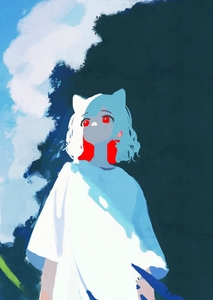
Kana puts the wig on my head with the careful hands of someone who is doing something she has decided to commit to fully having decided to commit to it at all. Her hands are light. Precise. The wig settles.
She steps back.
Looks at me.
The complete form.
The small smile arrives without announcement.
"You're —" she starts.
"Don't," I say.
"You're —"
"Kana."
"Very," she says, quietly, with complete sincerity, "cute."
I look at the sky above the school building.
The committed grey.
Still deciding what it wants to be.
I am a very manly person.
"Outside," Sky says. "We're going outside. It's a nice morning. We should be outside."
"It's grey," I say.
"It's a nice grey," she says. "Come on, Mii-chan."
"Don't call me —"
"Mii-chan," she says again, already moving. "Kana, make sure Mii-chan follows."
Kana looks at me.
"I'm not going to run," I say.
"I know," she says. And falls into step beside me.
Outside.
The three of us.
The specific quality of the outside of a school building on a Friday morning — the air cooler than the inside, the grey sky doing the grey thing, the particular light of a day that hasn't decided yet whether it's going to be good or bad or just a day that happens to people —
Sky is talking.
She's been talking since we came outside. Telling a story — not the true story, obviously not the true story, a story she has invented with complete real-time confidence about how Mii-chan and Sky became friends, a story that involves a train delay and a shared umbrella and a particularly difficult vending machine that dispensed the wrong item three times before surrendering the correct one —
It's a very specific story.
It has details that feel true because Sky commits to them fully.
I listen to Sky invent my own friendship history.
My monologue catalogs the inaccuracies. There are fourteen. I file each one. The filing is automatic. The background process running the inventory while the foreground does what the foreground does which is stand in a school uniform and a wig in the specific grey light of a Friday morning and —
And then.
Sarah Kim.
She's there.
Just — there, just a person coming around the side of the building with her bag on her shoulder and her phone in her hand and the specific quality of someone who is in their own head, who is moving through the morning on their own track, who hasn't yet registered the three-person configuration by the corner —
I know her face.
Not from across the cafeteria. Not the constellation version. Close enough that the constellation resolves —
She's different.
She's —
The temperature this morning is approximately —
The grey sky has a specific texture, a layered quality, the clouds sitting at different altitudes producing a depth that —
Sarah's bag is on her left shoulder and she's looking at something on her phone and her face has the specific relaxed quality of a person who is —
Sky says something.
To Sarah.
I don't process what Sky says to Sarah because the grey sky is doing — the light is doing the specific thing that light does on grey mornings when the clouds diffuse it evenly and there are no harsh shadows and everything has a kind of —
"And this is Mii-chan," Sky says.
Sarah looks up from her phone.
She looks at Sky.
She looks at Kana.
She looks at me.
"Hi," she says.
Her voice is —
The vending machine to my left has the stuck button. The button is the one for the second item from the left on the third row and it has been stuck in the depressed position since at least September which means —
"She's cute," Sarah says.
She's looking at me.
At Mii-chan.
At the fiction standing in her school uniform and wig in the grey Friday morning light.
"Completely adorable," she says. And smiles.
The smile is —
The pavement has the specific texture of school courtyard pavement, slightly rough, the kind that produces a particular sound when you walk on it and I know this sound, I've walked on it, I walked on it in the photo in the shoebox in the far left corner —
My internal something is —
The grey sky.
The pavement.
The stuck button on the vending machine.
The fourteen inaccuracies in Sky's invented friendship story.
Kana's hands which are still slightly warm from when they were around my arms.
The east stairwell which smells like the cleaning product on the pipes along the upper wall which I identified through investigation because investigation felt more productive than peace and peace has never come particularly —
Sarah is smiling at Mii-chan.
She moved on.
I can see it.
Not from across the cafeteria. Not the constellation. Close enough to see — she moved on, she carried it, she set it down, she kept going, she is a person who exists in the world without the weight of what happened defining her entire presence, who laughs and calls strangers cute and smiles at someone she doesn't recognize as the person who used to make her feel small —
She changed.
That's the observation.
She changed.
I'm filing it and moving on.
"Nice to meet you, Mii-chan," Sarah says.
She goes.
She walks away and becomes a person moving through the Friday morning on her own track and the track has nothing to do with me and the me she doesn't know she just met and the constellation that doesn't resolve from this distance because she wasn't looking for it —
The grey sky.
The pavement.
The fourteen inaccuracies.
Sky looks at me.
Something on her face.
The model breaking again.
She doesn't say anything.
For approximately seven seconds Sky Sono says nothing.
This is — I've catalogued her silences, I've been cataloguing her silences since the forty-second walking silence on the route, and seven seconds of Sky saying nothing is the longest silence I've recorded from her, is longer than the oki silence and longer than the pointless silence and longer than the composure crack which was 0.7 seconds —
Seven seconds.
Then she puts her hand on my shoulder.
Not the head. The shoulder. Not my mother's left shoulder. The right one. The baseball shoulder. The shoulder that still has the faint memory of an impact from Monday morning when a person I had known for approximately four minutes threw a baseball at my face to see what I'd do —
She puts her hand there and doesn't say anything.
Just — the hand.
Just the pressure of it.
Kana on my other side.
Also saying nothing.
Also just present.
Just — there.
The three of us.
Outside.
In the grey Friday light.
The pavement doing its pavement thing.
Sarah already gone.
Changed.
I'm not going to say what I'm feeling.
I'm going to tell you about the stuck button on the vending machine.
The button has been stuck since September which means it's been stuck for —
"Mii-chan," Sky says.
Her voice is different.
Just slightly.
"Yeah," I say.
"She looked happy," Sky says.
I look at the vending machine.
"Yeah," I say.
The grey sky.
The pavement.
Kana very still beside me.
Yeah.
Comments (0)
Please login or sign up to post a comment.